Showing posts with label science. Show all posts

Wednesday, December 17, 2014

Let's Go Sailing

And what will we see? The ugly footprint of what we've done to the oceans is what. I tell you, the more I think on it, the more disgusted I've become with what we humans have done to the only planet we have.

A walk on the beach in Mumbai
What you see here in the photo is the shit you can see. What you cannot see nobody but deep-diving deep sea drones can see. And that is a universe of plastic on the sea floor. In recent years the production of plastic has quadrupled, so scientists expected to find much much more of it at the surface than they did.

That's because it's not there. It's down at the bottom of the oceans and seas.

The discovery of microplastic in such remote marine habitats raises new questions about the potential for plastic debris to contaminate the food chain. Scientists have already documented that fish, birds, turtles, and other marine animals eat plastic. Thompson and his team found an even greater accumulation of plastic than previously suspected. The more plastic there is, he says, the more potential for toxicity to marine life.

In the study, Thompson and his team concluded that every square kilometer of deep ocean contains about four billion plastic fibers—most are two to three centimeters in length and as thin as a human hair. The fibers are four times more abundant in the deep sea than in surface and coastal waters.

"Our results show evidence for a large and hitherto unknown repository of microplastics," Thompson wrote. "The prevalence of microfibers in all sediment cores and on all coral colonies examined suggests this contaminant is ubiquitous in the deep sea." source
 Isn't this wonderful news?

Wednesday, November 12, 2014

Out of this World

It's 300 million miles away!

How can we be such idiots on the face of the earth? I mean all the useless killing, the king's ransom countries pay for weapons and killing instead of for human needs, the heedless pollution of our planet, and our determination to destroy ourselves by continuing to heat up the Earth until it cooks us all. And then one day the news tells you that human beings have succeeded in landing a craft on the surface of a comet speeding towards the sun at over 34,000 mph. Landing a craft from an orbiter of the comet which has been there for a number of weeks. An orbiter that took ten years to rendezvous with this comet. This kind of thing truly takes my breath away. How is it that creatures who can do this--and not just do it, but have a burning desire to do it--cannot figure out how to live in peace with their fellow man on the only home we have?

This mission, carried out by the European space agency, promises to provide tons of information we don't have now about the composition, makeup, and behavior of these plenteous citizens of the solar system. They hold keys to the origins of the universe itself. Wow. Stupendous.

Wednesday, September 3, 2014

You Learn Something New Every Day

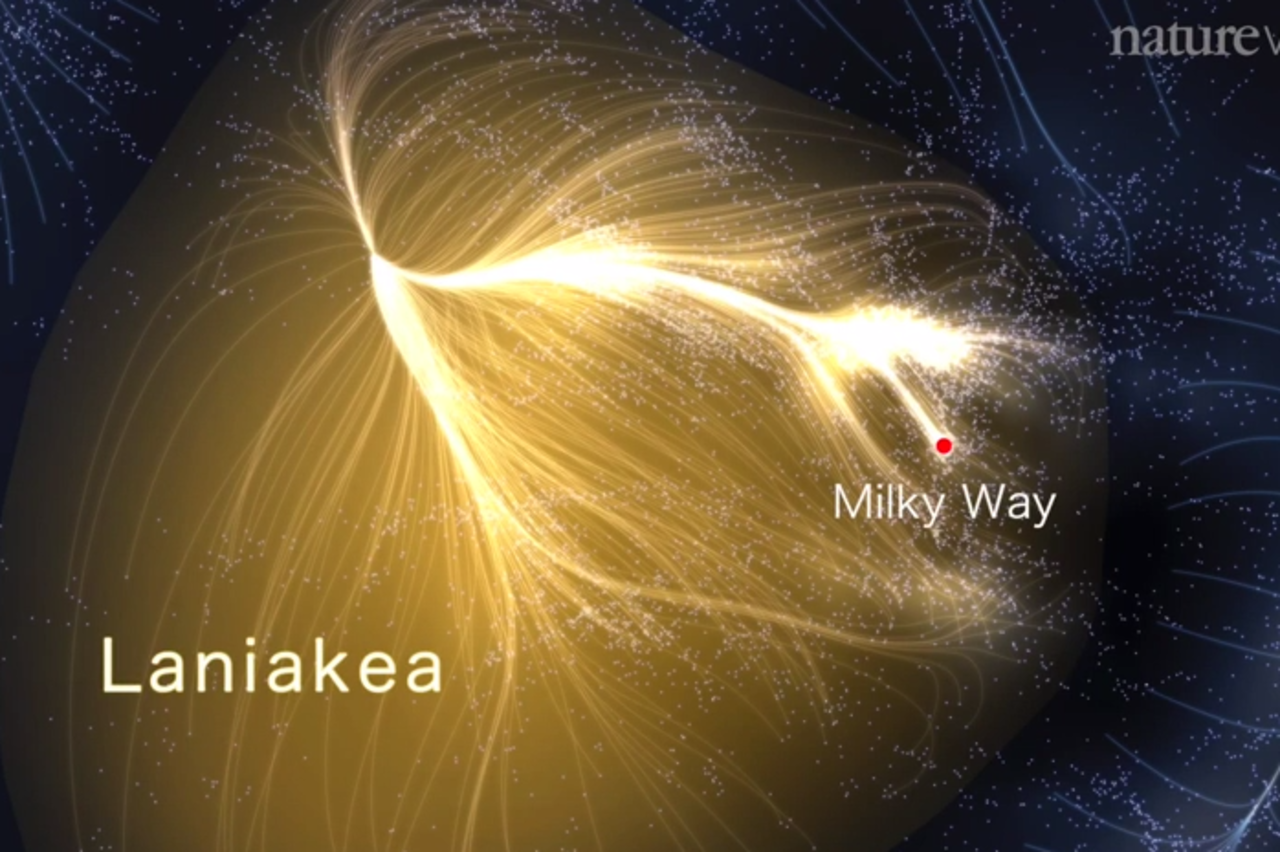
But you don't learn something like this necessarily. It seems that all those galaxies we see around us are part of a so-called super cluster, which is but one of God knows how many super clusters comprising the known universe. Here is the picture of our super cluster, which is named Laniakea, and our galaxy's place in it. Way out on the fringe. 

Words Fail . . .
This is a short video, from which the still above is taken, will give you some conception of the miracle we're talking about here. My mind simply boggles at how the human brain is capable of figuring out such things. We didn't know this ten years ago . . . what will we learn in ten more?


Oh, and here's the article that explains all this: right here.

Monday, August 25, 2014

Poof!


Sparky
 Astronomers have for the first time caught a glimpse of the earliest stages of massive galaxy construction. The building site, dubbed “Sparky,” is a dense galactic core blazing with the light of millions of newborn stars that are forming at a ferocious rate.

The discovery was made possible through combined observations from NASA’s Hubble and Spitzer space telescopes, the W.M. Keck Observatory in Mauna Kea, Hawaii, and the European Space Agency's Herschel space observatory, in which NASA plays an important role.

A fully developed elliptical galaxy is a gas-deficient gathering of ancient stars theorized to develop from the inside out, with a compact core marking its beginnings. Because the galactic core is so far away, the light of the forming galaxy that is observable from Earth was actually created 11 billion years ago, just 3 billion years after the Big Bang.

Although only a fraction of the size of the Milky Way, the tiny powerhouse galactic core already contains about twice as many stars as our own galaxy, all crammed into a region only 6,000 light-years across. The Milky Way is about 100,000 light-years across.
(Source)

 And we are under the illusion that our affairs are . . . what's the phrase "earth-shaking"? That our experiences are of consequence. That somehow what we say and do matters. What truly is earth-shaking is that there is no word in any language I know to describe how tiny and insignificant we are. Nothing we can say or think can capture this immensity . . .

And yet we've discovered the science to reveal this all to us. And we keep having these questions that won't go away.

Sunday, December 15, 2013

Utterly Amazing

You have to check this out. When you open the link, slide down a little to see the .gif run. Sorry for all the extraneous stuff that comes with the URL. I could not figure how to get rid of it.

This gif of a microscopic bacterium is the most amazing thing you’ll see today

Excerpt:
Once you’ve picked yourself up off the floor in amazement, you’ll probably want to know exactly what you’re looking at in this image.

At the final stop in this gif, which magnifies many times, is a tiny bacterium, which is resting on a diatom, (a class of algae that are known for their silica shells), which is sitting on an amphipod, a type of shell-less crustacean.

We think that Reddit user adamwong246 described it best:

There’s a bacterium on a diatom on an amphipod on a frog on a bump on the log in the hole in the bottom of the sea!

The animated gif was made by James Tyrwhitt-Drake using a scanning electronic microscope at the University of Victoria’s Advanced Microscopy Facility.

http://deadstate.org/this-gif-of-a-microscopic-bacterium-is-the-most-amazing-thing-youll-see-today/

Tuesday, November 5, 2013

Elementary Physics

I post to you today, verbatim and in its entirety, an email I received from a fellow history Ph.D. I tell you, brothers and sisters, it's stimulating sometimes to carry on conversation with such people. Here's the whole email:

As you all know:
. . . we have a standard model of elementary particles. Its ingredients are quantum fields, and the various elementary particles that are the quanta of those fields: the photon, W+, W-, and Z0 particles, eight gluons, six types of quarks, the electron and two types of similar particles, and three kinds of nearly massless particles called neutrinos. The equations of this theory are not arbitrary; they are tightly constrained by various symmetry principles and by the condition of cancellation of infinities.
Well, at least in my case, it helped a lot to read the article:
 http://www.nybooks.com/articles/archives/2013/nov/07/physics-what-we-do-and-dont-know/

I read the article too, and I have to say, I agree. And for those of you who want to be picky: you're right, the illustration does not match the quotation. So sue me.

Friday, October 26, 2012

Most detailed view of the Milky Way ever

This composite image shows more than 84 million stars in the Milky Way galaxy. (European Southern Observatory-10/25/2012)

Utterly fantastic!
Astronomers from the European Southern Observatory have released a striking new image of the Milky Way galaxy that shows more than 84 million stars, 10 times more than previous studies have provided. The zoomable image, constructed by computer-merging thousands of individual images, contains more than 9 billion pixels and would, if printed at the resolution of a typical book, measure 30 feet long and 23 feet tall.

The individual images used in the composite were obtained with the 4.1-meter (161-inch) Visible and Infrared Survey Telescope for Astronomy (VISTA) at ESO's Paranal Observatory in Chile. The survey was conducted at infrared wavelengths because visible light emanating from the stars near the center of the Milky Way galaxy is obscured by dust and gas surrounding the cluster of stars. VISTA is the largest telescope ever used to explore the central core of the Milky Way and it was used, in part, because that portion of the galaxy is visible only from the southern hemisphere. A team led by Chilean astronomers Roberto Saito and Dante Minniti reported their findings in the journal Astronomy & Astrophysics.

The team identified 173 million individual objects in the photo composite. Eighty-four million of them could be positively identified as stars; the remainder were more distant objects, such as other galaxies, or could not be unambiguously identified.

Using the data on which the image was based, the team was able to construct a diagram that charts the individual stars' brightness versus their colors. That allows the researchers to draw more information about the age and size of each star. The chart, for example, identifies red dwarf stars, which are thought to be valuable targets in the search for low-mass extrasolar planets. A separate study of the images, not yet completed, will search for pulsars, binary stars, starspots and other variable objects. (Source)

Wednesday, October 10, 2012

Gotcha!

This is a piece of amber about 100 million years old. Think about the odds of the tree sap imprisoning both these creatures at this exact moment. Fantastic. This is a gotcha on at least two levels, spider catches wasp, we capture both. I was thinking that there's no real analog to this sort of thing for humans. The closest, I would think, would be those poor souls at Pompei who were entombed in lava, but even there the connection is tenuous.

Spider capturing a wasp . . . 97 to 110 million years ago
"What makes this find so sensationally rare, aside from the fact that the amber clearly shows a snapshot of the spider moving in on the wasp, is the fact that the piece contains 15 unbroken strands of ancient spider silk within (the wasp actually sits captured in several strands)."

According to the story on CNet, both these genera are extinct, but their modern day counterparts are still at work doing the same things.

Friday, September 21, 2012

You're Entitled to Your Own Opinion

. . . but not to your own facts. A neat quotation from former NY Senator Daniel Patrick Monihan I recently learned from this New York Times piece.The piece reports good news, a ripening trend away from the asinine, insane journalistic practice that demands equal time for both sides of the story, no matter the established truth on one side. The article refers to this as "false balance." Take for example, the so-called debate over the "theory" of evolution and creationism, under-girded by "creation science," of course. And then there is global warming, a fact accepted by an overwhelming majority of scientists, and yet our lamestream media sometimes portrays it, this fact of the warming of the globe, as something that is in dispute on scientific grounds.
"Recently, there’s been pressure to be more aggressive on fact-checking and truth-squading,” said Richard Stevenson, The Times’s political editor. “It’s one of the most positive trends in journalism that I can remember.”

It’s all a part of a movement — brought about, in part, by a more demanding public, fueled by media critics, bloggers and denizens of the social media world — to present the truth, not just conflicting arguments leading to confusion.
This can only be a good thing. The whole article is worth reading.

Thursday, September 20, 2012

Cannabidiol

Just to balance off yesterday's story about people going to jail for possession of tiny amounts of that "dangerous" drug marijuana, here comes a story that's truly amazing. It appears that a non-psychoactive component of the marijuana plant, a substance called Cannabidiol or CBD, acts to turn off the gene that causes cancer to spread. Got that, folks? We're talking about a possible breakthrough that will kill metastasizing cancer cells. Laboratory results show that the substance acts on This is HUGE. The two California scientists who have made the discovery are hoping for a quick approval to begin testing with human subjects. Lab tests and tests on animals have already been done with the astonishing results now coming to light.  (Read the story here.)

Monday, August 13, 2012

O Mars!

Curiosity is the greatest thing since the last Mars Explorers, one of which, Spirit, I think is still roaming around Mars five years later. But this new vehicle. My goodness. Did you get a load of the way it got to the surface of Mars? Right where it was supposed to land? I mean, are you kidding me? This is fantastic. This is the sort of thing human beings can do instead of killing each other.


Curiosity rover: Martian solar day 2 in New Mexico

Source: http://www.theverge.com/2012/8/13/3240137/360-degree-mars-panorama-curiosity-rover

[In case you're wondering, this is indeed Mars, not New Mexico as seemingly indicated on the panorama. Messages underneath at the source make that clear.]

Monday, August 6, 2012

The Curse of Science

"A rational world, a world that will protect the ecosystem and build economies that learn to distribute wealth rather than allow a rapacious elite to hoard it, will never be handed to us by the scientists and technicians. Nearly all of them work for the enemy."

Thus writes Chris Hedges in his latest column on Truthout. The occasion of his latest reflections was the anniversary of the atomic bombings of Hiroshima and Nagasaki, acts of barbarity that he, quite rightly, I think, believes were totally unjustified by the necessities of war and which stand with the Nazi killing camps at the pinnacle of the mountain of horror we have constructed with our science and technology. It's in our natures, he argues, for us to act like beasts. And we have made a false and cruel god out of science. "Science is for us," he writes, "what totems and spells were for our premodern ancestors. It is magical thinking. It feeds our hubris and sense of divine empowerment. And trusting in its fearsome power will mean our extinction."

I certainly see little reason to disagree. Freud, Hedges reminds us, that human beings are creatures of dark impulses, "powerful yearnings for death and self-immolation." Scientific knowledge didn't free us from this. And then, this sobering observation:
The future of the human race depends on naming and controlling these urges. To pretend they do not exist is to fall into self-delusion. The breakdown of social and political control during periods of political and economic turmoil allows these urges to reign supreme. Our first inclination, Freud noted correctly, is not to love one another as brothers or sisters but to "satisfy [our] aggressiveness on [our fellow human being], to exploit his capacity for work without compensation, to use him sexually without his consent, to seize his possessions, to humiliate him, to cause him pain, to torture and to kill him."
Of the guys I regularly read, Hedges is the most overtly moralistic. For me, his passion is perfectly understandable. He looks around at the world and what he sees frightens and disgusts him. Humanity is choosing its own destruction. It persists in "innate human barbarity."

So during our own period of political and economic turmoil, we should probably expect the worst, unless something miraculous happens that lets us see.

Tuesday, May 22, 2012

One Minute Physics


Well, it's not really a minute, but it goes by really fast--a little too fast, actually--and the learning part doesn't even take up the whole video. But this is pretty cool.

I found this right here.

Wednesday, March 21, 2012

Where No Man Has Gone Before

A Patch of Mercury . . . in cool blue
 Did you know that we've had a scientific mission to Mercury going on? That a satellite has been circling the small planet nearest the sun for the past year? I'll bet it may have crossed your consciousness at one point, but that it's long since taken leave. And the media is not much help. Reporting these matters will never trump stuff like celebrity and sports news, much less the latest blather from politicians or stuff about our endless wars. So you stumble over fascinating articles like this one that remind you that truly monumental things are happening whilst we go about our mundane tasks.

No mission to any place in our solar system has ever not provided surprises. In the case of Mercury, scientists have been amazed to discover that geological activity (i.e., volcanic, tectonic) continued on the planet far, far beyond the time it was previously thought to have been possible. And measurements of the gravity of the planet on the Messenger spacecraft have revealed that the core of the plant is much, much larger than Earth's. So the mantle and crust of the planet Mercury are quite thin, like the peel on an orange compared to the interior. Who knows what other wonders await our discovery out there?

I'm wondering if there's some invisible satellite circling us . . . measuring our interiors.

Wednesday, January 25, 2012

And God Said, "Let There be Morons."

This is the kind of thing that confirms us as idiots in the eyes of the world:
An Indiana Senate committee on Wednesday endorsed teaching creationism in public schools, despite pleas from scientists and religious leaders to keep religion out of science classrooms.
Senate Bill 89 allows school corporations to authorize “the teaching of various theories concerning the origin of life” and specifically mentions “creation science” as one such theory.
State Sen. Scott Schneider, R-Indianapolis, who voted for the measure, said if there are many theories about life’s origins, students should be taught all of them. (Source)
 The vote in the Senate Education Committee wasn't even close: 8-2. Now the bill will move on to the Republican-controlled Senate. If it passes, the school districts of the state will have the option teaching intelligent design as a theory explaining the origins of life right alongside the "theory" of evolution in science courses. (Source)

Creation science is to science as justice is to military justice. This is ridiculous. You know, I just have to shake my head. I grew up (and was educated) in a time when science and scientific learning garnered respect. Now, in some quarters, if scientists teaches it, it is wrong. This creation science bit and the denial of global warming are just two of the most visible of this disturbing trend. What is a normal person supposed to make of this? I find it scary.

Thursday, January 19, 2012

Wait a Second . . .

I got to thinking about the last bullet from yesterday's entry. I heard on the radio today--well, actually, it was on my iPod, and it was a recent episode of "This American Life" that reminded me about this. I remember the figures given there were like this. In 2006, a reputable poll recorded that 79 percent of Americans accepted the fact that human-stoked global warming (that is, a substantial increase in greenhouse gases, carbon dioxide, in the earth's atmosphere) was a fact. (I refuse to use the term "believe in" when referring global warming, as if we were talking about Santa Claus rather than a scientifically-verifiable fact.)  Three years later, that figure had dropped to 46 percent. 

So wait a second . . . what the hell is going on here? Okay. Let's do the logic. Who would gain if human-stoked global warming were not a fact? Who would gain if all these alarms about greenhouse gases would just go away? The answer is obvious: every industry associated with carbon dioxide emissions. And guess who these industries are? Did you guess industries connected in any way with fossil fuels? Gold star for you! and don't forget all the associated industries, the pilot fish on the bodies of traditional energy companies. By all accounts, the largest effort to debunk global warming has come from ExxonMobil. The oil giant has mounted a sophisticated, worldwide campaign that has obviously succeeded. And of course, their lackeys in Congress have assisted them. This campaign has been hugely successful. Just look at the numbers.

Of course, this kind of corporate hooey can only be swallowed if people are uninformed. Need I rail once again at the woeful ignorance of the American people on a vast number of subjects? I'm sure you're tired of hearing it.

This is a very interesting website: The Global Warming Portal

Thursday, December 29, 2011

Something We Need to Remember

This was interesting, I thought. From my friend Bob Becker. Just another way of seeing how dumb we really are. You'll probably have to spin this up to a size where you can read it. Sorry I could not get it bigger here and still fit.

Tuesday, December 20, 2011

Word: Smart Bird

Pigeon performing a math test.
Interesting piece today in the Times about a subject that interests me greatly. That would be birds. My kids and family are well aware of my fascination with our feathered friends. In fact, I get unshirted hell about it from my kids. I don't think I could ever have the time it would take to get to be real, official bird-watcher, but I've always found these creatures endlessly interesting. They figure in quite a number of my poems, for example.

Anyway, scientists have discovered hitherto unknown talents in an unlikely candidate for bird stardom, the ubiquitous pigeon. We've known for a while that these guys could count. Apparently lots of animals can count. Some time back we learned that monkeys "learned to rank groups of one, two and three items in various sizes and shapes. When tested, they were able to do the task even when unfamiliar numbers of things were introduced. In other words, having learned that two was more than one and three more than two, they could also figure out that five was more than two, or eight more than six." Now, it turns out that pigeons can do it too.

Amazing. Question now arises whether this ability evolved from the common ancestor of birds and primates about 300 million years ago or separately in the different species. Jury is still out on that one.

Monday, December 12, 2011

Finding God [or a Particle of Him, at least]

Various subatomic particles: Higgs Boson is not found yet.
Grab your thinking caps, brothers and sisters. Let's dip into theoretical subatomic physics, shall we? Remember that monstrous particle accelerator (it belongs to CERN, the European Organization for Nuclear Research) that took years to build over in Europe on the French/Swiss border? (It could have been in the US, as I recall, but we would not fund it.) Well, it's doing exactly what it was built for, smashing teeny little particles of matter into each other at unbelievable speeds. BOOM! They crash into each other and produce showers of subatomic particles, which scientists can then study. (Don't even ask me about how the photos of these crash aftermaths are taken.)

Since the early 1960s, a particularly important and striking subatomic particle has existed in theory only. It is called the Higgs boson or "the God particle." And why the nickname? Well, finding this thing would be a major step forward in our knowledge of what makes everything work, i.e., a key step on the road to the unified theory of everything. Physicists have figured out how both radioactive and electromagnetic forces work, "But they need to find the particle to complete their understanding of how these forces work together at the atomic level." As I understand it, explaining how matter acquires mass is and has been an elusive question. And in the crazy world of subatomic physics which is subject to the completely counter-intuitive laws of quantum mechanics, a particle can theoretically impart mass to other particles. This magical guy is the Higgs boson.

Finally, with all that background, I can impart the big news: physicists at the CERN lab report "they have seen evidence of the God particle's existence." The results they are studying are "tantalizing" but not a "conclusive" detection of the Higgs boson. By the end of next year, scientists are confident that experiments will be definitive, and the God particle will be conclusively proven to exist.

So is God going to be subatomic? Of course . . . among other things, not the least of which is elusive and mysterious.

Tuesday, November 1, 2011

Great Websites

For various reasons.
  • Ninjawords: Doesn't everybody have a dictionary link on their toolbar? I cannot imagine anybody not having one. But till I discovered Ninjawords, I had to wait wait wait for the dictionary site to come up, type in the word, and wait for the system to grind out the word and definition. No more. If all you want is a quick definition, this dude will blow your hair back. Try it. Info about it here.
  • Wikisky: The kind of place that makes me realize just how little I know. But it fascinates me nonetheless. This is an astronomy site that you have to see to believe. Here's their own description of what it is: "Our on-line system is a detailed sky map. We generate the map automatically using our database with the positions and basic characteristics of space objects. You can get more details from Getting Started." I get lost here every time I go.
  • Kiva: Lend some money to some enterprising citizen of the developing world. Help them stand up a business, do yourself proud, and love your neighbor all at the same time. "[A] non-profit organization with a mission to connect people through lending to alleviate poverty. Leveraging the internet and a worldwide network of microfinance institutions, Kiva lets individuals lend as little as $25 to help create opportunity around the world."
  • Wikitravel:Wiki again? Yep. This is a Wiki Travel Guide. It's got over 25,000 destination guides and other articles for planning travel. Look up close by (ton of stuff on Oklahoma City) or what you're thinking about (rail travel across Canada). Tons of great information.