Showing posts with label environment. Show all posts

Thursday, January 1, 2015

Happy New Year

"Some Assembly Required" is worth quoting at length today:

New Year's Day is an arbitrary and mostly fictional marker. It is common to pretend that some clear divisor has been set between what was and what will be. But that is a fiction mainly used to peddle prognostications that turn out to be as false as the occasion. 
 
For my part, I believe that more of the same will predominate, as always. History creeps in when we're not looking. We're told that the good times will continue, but most Americans won't know what the pundits are talking about. If times are so good, why are the majority of Americans worse off? The reality is that there has been little if any recovery over the last four years. Or eight, to give Obama his due.
More of the same: the global economy will not seize up suddenly and leave us all to starve in the dark, but it won't change much for the better, either. Wars and atrocities and inequality and rape and torture will all go on, and go on being ignored. So will the hollowing out of the American middle class, as what once were government prerogatives of a self-governing people continue to be treatied away to international corporations. 
 
Police will continue their extra-juridical execution of lower caste young men and the streets will pulse with ineffective protests – because protesting in the streets will not change the balance of power. Dying in the streets in large numbers might, but not any time soon.
The number of Americans trying to survive without a job will continue to increase, the effective standard of living for most of the population will continue to decline. The dollar is not going away and neither is the euro; high priced oil will return as fracking starts to subside, and climate change will continue to be ignored as we not-so-slowly burn our way to oblivion. The world’s finite supplies of petroleum, along with most other resources on which our extractive civilization depends, will continue depleting while we continue our blind faith in forever.
More of the same. We'll call it progress.

Wednesday, December 17, 2014

Let's Go Sailing

And what will we see? The ugly footprint of what we've done to the oceans is what. I tell you, the more I think on it, the more disgusted I've become with what we humans have done to the only planet we have.

A walk on the beach in Mumbai
What you see here in the photo is the shit you can see. What you cannot see nobody but deep-diving deep sea drones can see. And that is a universe of plastic on the sea floor. In recent years the production of plastic has quadrupled, so scientists expected to find much much more of it at the surface than they did.

That's because it's not there. It's down at the bottom of the oceans and seas.

The discovery of microplastic in such remote marine habitats raises new questions about the potential for plastic debris to contaminate the food chain. Scientists have already documented that fish, birds, turtles, and other marine animals eat plastic. Thompson and his team found an even greater accumulation of plastic than previously suspected. The more plastic there is, he says, the more potential for toxicity to marine life.

In the study, Thompson and his team concluded that every square kilometer of deep ocean contains about four billion plastic fibers—most are two to three centimeters in length and as thin as a human hair. The fibers are four times more abundant in the deep sea than in surface and coastal waters.

"Our results show evidence for a large and hitherto unknown repository of microplastics," Thompson wrote. "The prevalence of microfibers in all sediment cores and on all coral colonies examined suggests this contaminant is ubiquitous in the deep sea." source
 Isn't this wonderful news?

Tuesday, July 15, 2014

It Never Goes Away

I've gotten to the point where I almost feel guilty dealing with anything that's plastic. It is so ubiquitous. From where you're sitting right now, how many things can you see that are plastic or contains plastic components? Thank goodness I can salve my conscience some by recycling all the plastic waste this one little household with only two people in it generates. But I know it's just the smallest atom of help for a problem that staggers the imagination.

Plastic, Plastic Everywhere: Plastic, that handy, lightweight, nearly indestructible stuff is... well, indestructible. We throw a lot of it away, but for plastic there is no 'away'. Most of it ends up in landfills, where it will sit for a few thousand years. A tiny bit, about 9% of the US share, gets recycled. A lot of it ends up in the ocean, about a million tons so far. Of that vast amount, about 35,000 t ons has ended up in those swirling garbage patches – every ocean has at least one of them. But the 965,000 plus other tons of seaborne plastic has just 'disappeared'. But plastic doesn't simply disappear. It'll be back. Shut up and eat your fish.

Friday, April 25, 2014

A Rousing Amen! to This

The Wheels On The Bus: the richest 85 people on the globe – who between them control as much wealth as the poorest half of the global population put together – could squeeze onto a single London double-decker bus. The top 1% have $110 trillion in assets. That's 46% of all the wealth in the world. And that's not right. There is absolutely no way to morally justify such rapaciousness, not while a single child goes to bed hungry, anywhere in the world.
Numbers like this are so astonishing, they take your breath away. I might note that you can bet your bottom dollar this 85 richest in the world are contributing the lion's share of the desecration of the planet that will probably snuff out human life as we know it within a century. The only consolation, and it's a pretty small one at that, is that even all their money won't be able to stave off environmental calamity. 

Wednesday, April 23, 2014

BP Oil Spill Redux

Dead Sea Creatures on Gulf Beach -- BP Victims Four Years Later

Four years ago now--hard to believe--that BP's underwater broken oil well gushed almost 5 million barrels of crude oil into the Gulf of Mexico. And the so-called "cleanup" spread 2 million gallons of toxic chemical oil dispersant into the water also. This article has the sordid details. The oil spill residue--and it's out there in millions of gallons on the sea floor--is still killing plant life, fish, birds, dolphins, turtles, and sickening crab, shrimp, and humans. It has permanently and seriously hurt the seafood industry in the Gulf states. It has brought some species to the brink of extinction. People in the affected area--Louisiana, Mississippi, Alabama, and Florida--are showing all manner of health problems connected with the oil and the supposedly harmless dispersant. The long and the short of it is this is a disaster that will be afflicting the environment and economy in the Gulf region for countless years to come.

But are you ready for the real bottom line?
Despite all of this ongoing evidence of BP's deleterious impact on the Gulf of Mexico region, President Obama's Environmental Protection Agency has decided to allow the oil giant back into Gulf waters to search for more oil leases.
What the hell is wrong with us?

Thursday, April 17, 2014

I Fear We Won't be Growing Up

Growth is good? In most of the world economic growth is the magic elixir that everyone strives for, lots and lots of growth. Endless growth. Growth gained by using energy to turn resources into garbage. More energy, more cars, more TVs, more and more and more. Especially more CO2 emissions. Growth. Too bad that growth will doom us. Or has.  Source
Me? I think we've already crossed the Rubicon on climate change. Things are irreversible, and the generations behind us are the ones who are really going to have to suffer.  

Monday, March 17, 2014

Sound Familiar?

A NASA funded research paper says that our unsustainable consumption of resources, our excessively large population and the increasing levels of inequality will lead to “irreversible collapse.” This is not exactly a fringe group of doomster conspiracy nuts. The authors cite compelling historical data showing that "precipitous collapse - often lasting centuries - have been quite common” throughout history. The main factors leading to civilizational collapse have been excess population, changing climate, high levels of economic stratification, water shortages, agricultural failure and failing energy sources. Sound familiar?

source: http://ckm3.blogspot.com/2014/03/sar-14076.html

Monday, January 13, 2014

A Likeable Guy

I'm really beginning to like this guy. A bald old geezer--just like me, except I have hair--who's just pissed off about things most of the time. His name is Charles Kingsley Michelson, III. And really irritated by the shallow "thinking" that underlies the lies most people in this land of the free believe.* I should say I liked this guy from the beginning, and now he's really growing on me.

To wit:
A Dollar Saved: How could the massive credit card security hacks like the recent Target debacle be stopped? With chip and pin cards. Never heard of them? They've been used in Europe since 1992 and have cut credit card fraud by over 80%. Why aren't they used in the US? a) It would cost the bankcard companies money. b) see a. c) Think about a and b. 
 
Preying The Odds: Senator Inhofe (Ignoramus – OK) claims that “fewer and fewer” senators believe in the climate change 'hoax', vs the 1 out of 10,000 scientists who doubt the reality of global climate change. 
 
Where The Money Goes: Just how much do we spend on welfare? $75 billion in food stamps, $55 billion in Earned Income Tax Credit, $43 billion in Supplemental Security income payments, $21 billion in Temporary Assistance for Needy Families, and $18 billion in housing vouchers for the poor. That's a bit over $200 billion, less than we spend on killing Muslims our Middle Eastern oil wars.

Trend Spotting: In the last 500 years, every instance of mass spying on the populace led to the government crushing dissent. It was never, ever, done to protect anyone but the rulers.

Use It Or Lose It: In their blind hatred of Barak Obama, the far right has persuaded a compliant Supreme Court to hear their case for ending Presidential recess appointments - even though in his two terms he has made the fewest such appointments out of the last five Presidents. Have they given up all hope of ever getting one of their kind back in the White House?

Consequences: The cuts in services for seniors caused by the sequester's reduced funding are resulting in higher public costs for senior care because the programs that permitted many to continue healthy, independent living are being cut back. Sometimes a little public spending prevents both private suffering and increased public spending. It's called foresight. 
 
Asked & Answered: “Did Ariel Sharon get a pass on war crimes because he was white?” No, because he was an Israeli. 
 
A Quote: “Right now Republicans are doing all they can to hurt the poor, and they would have inflicted vast additional harm if they had won the 2012 election. Moreover, G.O.P. harshness toward the less fortunate isn’t just a matter of spite...; it’s deeply rooted in the party’s ideology...” Sure it's Krugmann; but he's right.

Bye, Buy, American Pie: Are subprime mortgages an endangered species? No, but they may become a rare thing, not because they can't be made under a reformed Wall Street, just that it'll be harder to palm them off on innocent investors as Good Investments and the banksters' fees will be limited, so there will be a lot fewer such loans. Whether this is a Good Thing depends, like so many things, on a lot of other things. Full disclosure and educated borrowers being just the beginning.
*Just as an aside: I found out that well over 100 people list their profession as "curmudgeon" on Blogger. You can find a list of them here.

Wednesday, January 8, 2014

Native American Insight


Only after the last tree has been cut down, the last fish has been caught, the last river poisoned will you realize that money cannot be eaten. Cree Nation Tribal Prophecy.

To encounter the sacred is to be alive at the deepest center of human existence. Sacred places are the truest definitions of the earth; they stand for the earth immediately and forever; they are its flags and shields. If you would know the earth for what it really is, learn it through its sacred places. [There] you touch the pulse of the living planet; you feel its breath upon you. You become one with a spirit that pervades geologic time and space. N. Scott Moomaday

Friday, October 11, 2013

Dead Spider

He was big, and he was black with long legs, and he was sitting by the back door to the house, the one from the bedroom to outside. I've been telling people for a long time that I don't kill spiders, that they are good creatures, that they do a lot more good than they do harm. But last night I picked up a shoe and smacked this one. He immediately folded up his legs, quivered, and died.

And I can't tell you how much that image's been on my mind. That dead spider with his curled up legs. The rationale at the time was he was big and scary and he might be dangerous, but this was just giving myself permission to kill him.

The fact of the matter is I feel bad about killing the spider. Isn't that nuts? Somehow, though, it feels like a violation of the pact that exists between all living things: the pact of mutual respect, the pact of being fellow travelers in the world. Maybe having the new dog in the house has stirred up these thoughts of the connection between ourselves and the rest of God's creation. I don't know. But whatever has caused it, I know that I've got a different outlook on living creatures than I did previously. Call it an enlargement of vision. Or call it the silly ruminations of an old man. Whatever: I still feel it.

Saturday, September 28, 2013

Chomsky on One of My Favorite Themes

And that would be the real danger we face from stupid people.


Don't know about you, but I find this hard to argue with. And it's not without humor either.

Wednesday, September 11, 2013

Politics Turns Off Conservative Brains


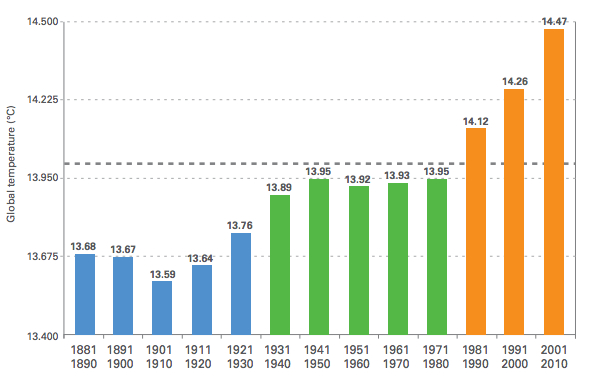
What you see above is a graphical depiction of the world's temperature over the past 110 years. Any idiot can see that it's a hell of a lot hotter now than it was 30, 50, 80 years ago. Right? Wrong! A recent study has indicated that "whether or not people got the question [involving fairly complex math] right depended on their political beliefs — and whether or not the correct answer supported their preconceived notions of [an issue, such as climate change]. . . . Conservative Republicans were much less likely to correctly interpret data suggesting that [global warming was happening]; for liberal Democrats, the exact opposite was true. The people who were normally best at mathematical reasoning, moreover, were the most susceptible to getting the politically charged question wrong."

Now ain't that interesting?

Thursday, August 22, 2013

If You Can't Say Anything Good . . .

So they say if you can't say anything good, you shouldn't be saying anything at all. It appears that that's been the case since I've gotten back from Florida, which now seems like it was a long time ago. But in fact this been very little good news since my return. (Aside from the wonderful winning ways of the Texas Rangers lately.) But rather than say nothing at all, let me just give you a few short bullets about what's happened in the past week – all the good news:
  • The Fukushima nuclear power plant in Japan has leaked another 300 tons of radioactive water into the soil. You will not believe how much radioactive water has been released into the ocean and into the ground there since the 2011 tsunami. It is staggering. Scientists don't really know what the long-term effects of this is, but – surprise! – They are concerned about marine life. Check out this article.
  • A military judge has sentenced Pfc. Bradley Manning to 35 years in prison for leaking classified information. Manning is a whistleblower, he's not a traitor, he's not a criminal. It used to be that whistleblowing was adjudged an honorable thing to do. We are a long way from that in paranoid America today where terrorism and terrorists are everywhere.
  • Along with the security state apparatus, which is everywhere. We just found out that NSA "accidentally" collected the email communications – or was it Internet transactions? – of over 50,000 Americans who had no connection whatever to terrorism. Does anybody really believe these people at NSA or in the White House when they say anything at all about this domestic spying and how they've got it under control now? I don't.
  • Another crazy rube, admittedly "off his meds" with a gun in an elementary school. This time in Atlanta. Some brave soul in the school actually managed to talk him out of killing anybody, so nobody was hurt. But don't you worry: some idiot perfectly protected by the laws that the NRA has stifled will succeed in blowing a bunch of innocent people away with a gun in the not-too-distant future. There is no safer bet in America.
  • The Syrian government has killed hundreds of its own people with poison gas near Damascus. The USA Today this morning had a picture of about 25 dead bodies laid out on sheets, and most of them, or I should say all of them, were kids. There's something so repulsive about this so repugnant to human decency, that it puts a serious question to my pacifism. The last thing I want is for the United States to get involved in punching the Middle Eastern tar baby again, but the moral dilemma presented by something like this is almost insoluble.
  • Closer to home in the little city of Duncan, Oklahoma, three teenagers shot and killed a 22-year old Australian baseball player who was jogging near his girlfriend's home. They were bored and just decided to kill somebody, one of the thugs explained. They did it "for fun." Does this really need any commentary? It was a .22 caliber handgun. Story here.
Maybe I shouldn't be saying anything at all, huh?

Thursday, March 28, 2013

And They Gotta Live Here

Lemme balance off the bad news of the last post with some really good news in this one. I have for several years been aware of what I think is one of the grossest pieces of evidence of what's wrong with the planet and what's wrong with us. To wit: gigantic and monstrous dead zones in all of the oceans of the world--the Seven Seas--caused by concentrations of tons and tons of plastic debris. The so-called North Pacific gyre contains an estimated 100 million metric tons of plastic garbage . . . and that's just one concentration. If people could see this horrible mess, it might spur them to some sort of action. It's largely invisible because the oceans are so vast. Because the stuff breaks up into tiny bits, satellites can't capture pictures of this horrendous mess for all to see . . . but it's there and it's fouling the water and it's entered the food chain of countless marine animals.

It could do the job in five years.
But the good news is there are some pretty smart kids out there who have one characteristic they don't share with geezers like me. They have to live in the crap we are going to bequeath to them, and they've put their fantastic minds and imagination to cleaning up our mess. Here's the story:
19-year-old Boyan Slat has unveiled plans to create an Ocean Cleanup Array that could remove 7,250,000 tons of plastic waste from the world’s oceans. The device consists of an anchored network of floating booms and processing platforms that could be dispatched to garbage patches around the world. Instead of moving through the ocean, the array would span the radius of a garbage patch, acting as a giant funnel. The angle of the booms would force plastic in the direction of the platforms, where it would be separated from plankton, filtered and stored for recycling.
At school, Boyan Slat launched a project that analyzed the size and amount of plastic particles in the ocean’s garbage patches. His final paper went on to win several prizes, including Best Technical Design 2012 at the Delft University of Technology. Boyan continued to develop his concept during the summer of 2012, and he revealed it several months later at TEDxDelft 2012.
Slat went on to found The Ocean Cleanup Foundation, a non-profit organization which is responsible for the development of his proposed technologies. His ingenious solution could potentially save hundreds of thousands of aquatic animals annually, and reduce pollutants (including PCB and DDT) from building up in the food chain. It could also save millions per year, both in clean-up costs, lost tourism and damage to marine vessels.
It is estimated that the clean-up process would take about five years, and it could greatly increase awareness about the world’s plastic garbage patches. On his site Slat says, “One of the problems with preventive work is that there isn’t any imagery of these ‘garbage patches’, because the debris is dispersed over millions of square kilometres. By placing our arrays however, it will accumulate along the booms, making it suddenly possible to actually visualize the oceanic garbage patches. We need to stress the importance of recycling, and reducing our consumption of plastic packaging.” To find out more about the project and to contribute, click here.
More power. More power to these bright young people. We should be ashamed of ourselves that we've left them such a messed up world in so many ways. 

Wednesday, March 27, 2013

Among Other Things, Our Water's Rotten

There's a famous line in Hamlet where he says, "Something's rotten in the state of Denmark." (At least, I think it was him.) But there's more than one thing rotten in the state of the USA. You can write your own litany. I just want to talk about one: the watercourses of this nation. Inspiration from this piece I ran across recently. A long while back, I think it was in the Nixon administration, the Environmental Protection Agency was established to keep track of how we're screwing up the ecology of the nation and to enforce what laws the people passed to preserve it. Well, way down the line from then--and the environment was pretty screwed up then--we are here. And the EPA reports that more than half--MORE THAN HALF--the water in the United States is unfit for living things. 
Fifty-five percent of U.S. river and stream lengths were in poor condition for aquatic life, largely under threat from runoff contaminated by fertilizers, the U.S. Environmental Protection Agency said on Tuesday.
High levels of phosphorus and nitrogen, runoff from urban areas, shrinking ground cover and pollution from mercury and bacteria were putting the 1.2 million miles of streams and rivers surveyed under stress, the EPA said.
"Under stress"--a polite euphemism for "not fit water to support insect life and crawfish." Do you realize how filthy bad water has to be not to support a mud bug?

Thursday, January 19, 2012

Wait a Second . . .

I got to thinking about the last bullet from yesterday's entry. I heard on the radio today--well, actually, it was on my iPod, and it was a recent episode of "This American Life" that reminded me about this. I remember the figures given there were like this. In 2006, a reputable poll recorded that 79 percent of Americans accepted the fact that human-stoked global warming (that is, a substantial increase in greenhouse gases, carbon dioxide, in the earth's atmosphere) was a fact. (I refuse to use the term "believe in" when referring global warming, as if we were talking about Santa Claus rather than a scientifically-verifiable fact.)  Three years later, that figure had dropped to 46 percent. 

So wait a second . . . what the hell is going on here? Okay. Let's do the logic. Who would gain if human-stoked global warming were not a fact? Who would gain if all these alarms about greenhouse gases would just go away? The answer is obvious: every industry associated with carbon dioxide emissions. And guess who these industries are? Did you guess industries connected in any way with fossil fuels? Gold star for you! and don't forget all the associated industries, the pilot fish on the bodies of traditional energy companies. By all accounts, the largest effort to debunk global warming has come from ExxonMobil. The oil giant has mounted a sophisticated, worldwide campaign that has obviously succeeded. And of course, their lackeys in Congress have assisted them. This campaign has been hugely successful. Just look at the numbers.

Of course, this kind of corporate hooey can only be swallowed if people are uninformed. Need I rail once again at the woeful ignorance of the American people on a vast number of subjects? I'm sure you're tired of hearing it.

This is a very interesting website: The Global Warming Portal

Sunday, November 27, 2011

Truk

Front of 1930s era truck sunk in the waters around Truk since 1944
I actually knew about Truk (only now it's called Chuuk), knew that it was a battleground in World War II in the Pacific. But that's about all. I didn't know exactly where it was--somewhere down there in the southwest Pacific. I wasn't even clear on when the battle took place.

I found out: The island's lagoon was main base for Japan's South Pacific fleet and had a 45,000-man garrison. The island was heavily fortified and known to the Allies as the "Gibraltar of the Pacific." Operation Hailstone, launched by the United States with carrier aircraft in mid-February 1944 was one of the most important naval airstrikes of the war. Twelve Japanese warships, thirty-two merchant ships and 249 aircraft were destroyed, although the larger warships had moved to Palau a week earlier.

Japanese freighter struck by U.S. torpedo at Truk, 17 Feb 1944

This was long time ago--I would have been about six months old at the time. But I learn via HDNet World Reports that the idyllic lagoon, long a lure for divers who flock in there in their hundreds to enjoy the beautiful setting and the greatest shipwreck dive in the world, that a looming ecological catastrophe looms. Sunken tankers, not to mention all the other vessels, are reaching the point where they will break up* releasing millions of gallons of oil into the lagoon. This catastrophe would be worse than the Exxon Valdez Alaska spill. It would kill the lagoon and destroy the fragile, bare-existence economy of the island. There's a very expensive procedure by which the oil can be sucked out of the tankers, but the dirt-poor islanders cannot even afford to fix the potholes in their roads. Somebody else will have to pay. I nominate Japan. All in favor say "Aye!"

One of the things I most dread for my children and grandchildren is whatever the physical state of the planet will be in 40-50 years. How many other potential disasters like this loom that we don't know about? And will the world ever wake up to what humankind is doing to the planet? It's fast approaching the time when it will be too late.

*I didn't know this happened to metal ships, but it does. Apparently, this happens eventually to all submerged vessels. Note to self: need to find out more about this.

Saturday, August 20, 2011

You Think It's Hot Now . . .?

A friend of mine turned me on to this graphic today:


What you're looking at is a long range projection for the number of days over 100 degrees the country will experience at the end of this century. I'm not going to editorialize (for a change). Here, let me just let you read the text of the piece
THIS SPRING'S DEVASTATING WILDFIRES in Texas, Arizona, and New Mexico were fed by precisely the conditions that climate scientists predict for a warming Southwest: drought combined with extreme heat. In South Texas, searing temperatures arrived in June, creating a nightmare scenario in which the winter-spring fire season merged with the late-summer fire season. In Arizona, the Wallow fire burned 840 square miles, making it the largest in the state's history. The map below at left shows the number of days in which temperatures exceeded 100 degrees Fahrenheit for 1961-1979. The map at right shows the number of scorchers predicted for 2080-2099 in the Intergovernmental Panel on Climate Change's "high emissions" climate-change scenario (atmospheric CO2 at 850 parts per million by 2100)—a level we are on track to reach. —Paul Rauber