I'm talking about this new attitude I seem to have developed as I approach age 70. All of a sudden I just don't seem to care too much about all the things that used to rattle my cage. For example, I'm on the verge of quitting to watch the PBS News Hour every night every night. Why? Because it doesn't seem that important to me anymore. Plus, I've got disgusted with the way they are doing the news. Everything is a contest. In the political realm they have signed on to the silly notion that one idea is as good as another and that "balanced" coverage requires that idiocy be given equal time. The program, which I have never missed, doesn't engage me like it used to. In fact, it's just pissing me off now more than it is enlightening me. Is this a sign of terminal decrepitude, not to really care much anymore about all the foo-rah-rah going on. Seems like I've heard it all before.
Hell, I can always read the news if I choose. Fact of the matter is, I'd rather be reading. Television is largely a waste of time, except for baseball games, LSU football (which I'm almost ashamed to admit I am still a devotee of), Masterpiece, and a few other quality shows.
I guess I'm just getting tired of the same old shit, and hearing the same old shit promises and "solutions" from politicians, the same old shit coming out of Hollywood--I mean, how many good movies have you seen lately? The same ole religious shit that makes no sense and doesn't begin to grasp the gospel. Doesn't it seem that they're getting worse, or is that just me? I'm finding advertising, screaming capitalism, commercials – all just totally futile, and maddening. I'm sick to death of lies. Lies everywhere, but mostly from the mouths of so-called leaders. The real leaders, the ones who can see what the actual problems of the world are and want to address them realistically, humanely (instead of with smoke and mirrors or blah-blah-blah or more-for-me-less-for-you-is-the-answer), it seems to me are just ignored. I search in vain for some sort of moral, upright example of courage in leadership anywhere. Don't see it, except from people who cannot change much of anything. It's discouraging, brothers and sisters.
Maybe I've come to realize, after years of saying so, that things really are not going to change. Maybe what's left of my hope is draining away. I say this, but I don't know if I really believe it – that hope is draining away. It just feels that way sometimes, which is why I need to be around my kids and grandkids whose future stretches out before them and who can give an aging, cynical, but earnest historian and aspiring Christian an alternate viewpoint.
In the meantime, I'm just keep on working on my history stuff which certainly holds my attention and keeps me busy. Doing my poems, listening to my music. Loving my dear wife and chugging along. I'm resolved to read. Read more. I just started a new book on Gettysburg which is already got me quite engaged. I also intend to be a little bit more faithful about checking in here. We'll see how that works.
Or maybe, just maybe, all this is temporary and I'll be snapping out of it tomorrow or the next day. This is what used to be known as blue funk . . . now it's known as check your anti-depressant.
Showing posts with label pop culture. Show all posts
Showing posts with label pop culture. Show all posts
Thursday, August 15, 2013


Wednesday, December 5, 2012
Go See It
Go see Lincoln, Steven Spielberg's latest movie. It's a treat, and unlike Hollywood's usual performance with history, this time it gets it down pretty close to accurate. I saw it again yesterday for the second time, and to tell the truth, I cannot remember the last time I saw a movie more than once in a theater (DVDs not counting). Here's what I had to say about it to a gaggle of LSU historians I've stayed in contact with over the years when I first saw it, about ten days ago:
--Events depicted that never happened, some of them hokey, others just invented
Here's the IMDb page.
Here's the Rotten Tomato page.
This is another of Spielberg's masterpieces. There was so much that was right about the movie, that nit-picking its faults seems somehow unimportant, although we historians are to do it anyway. The film's meticulous attention to the tiniest details is something that characterizes it and can't possibly be appreciated with just one viewing. (I'm definitely going to see this again.) And the excellence in the portrayal of lesser characters in the story such as Alex Stephens, Gideon Welles, and U. S. Grant simply underscores the overall mastery of how he has caught the people, places, and the time in a narrative that rings consistently accurate. If there's been a better depiction of the American political process on screen, I don't know of it. I don't know which guys are going to be competing with Daniel Day-Lewis for the best actor Oscar, but I would not want to be one of them. He will win in a walk. And finally a Lincoln much more likely to reflect what the reality was will displace all those semi-deified cinematic images we've been carrying around in our heads all these years.There are certainly enough historical inaccuracies for people familiar with the period to wag the familiar scolding finger at Hollywood for not being more careful. But, truth be told, historians are almost always displeased with the way the movies depict a subject they are expert about. So you won't be surprised if I make the following critical observations.
--Events depicted that never happened, some of them hokey, others just invented
- Lincoln's conversation with a couple of black soldiers in the beginning of the movie. Never happened. Plus one of them claimed to be from the 2nd Kansas Colored Infantry. This unit existed and was black, but never left the Trans-Mississippi theater. 2nd Kansas did fight at battle of Jenkins Ferry in Louisiana in 1864, but absurd that hand-to-hand combat was depicted. Never happened, much less the wholesale slaughter of the Confederates (no prisoners) by the black troops.
- Singing of the "Battle Hymn of the Republic" after passage of the amendment in the House. Gimme a break.
- Vast public celebration in Washington after passage of the amendment. Never happened.
- The matters discussed at the Hampton Roads Conference between Lincoln-Seward and the three Confederate commissioners.
Here's the IMDb page.
Here's the Rotten Tomato page.
Wednesday, November 28, 2012
Are You Ready for This? The Stones at Fifty Years
| Rock 'n Roll will never die--but it will get damned ancient-looking. |
One more thing . . . are you ready for this? The average age of the Rolling Stones is higher than that of the US Supreme Court by a about a year and a half. You can look it up.
And if you're tempted to just O.D. on the Stones, Rolling Stone (the magazine) has a massive retrospective of what must be every story they ever did on the band for fifty years. You can find that right here.
Can't quit without just a little taste. This song is one you never hear played, but it's one of my most favorites. It's called "100 Years Ago" from the album "Goat's Head Soup," a great, but underrated album. That's Mick Taylor on the fabulous guitar work, a guy who never got enough credit in the band. He was superb.
Monday, October 15, 2012
Clown Monuments
Jame's Kuntsler's weekly blog entry this Monday concerns itself for the most part with an unusual subject, very unusual for him. But here let me let him tell it:
I am reflecting this week on Stephen Greenblatt's book, The Swerve: How the World Became Modern, which concerns itself with the mood of Europe in the early 1400s, but in particular the career of one Poggio Bracciolini, a poor boy whose beautiful handwriting took him to the center of power as secretary-scribe to the first Pope John XXIII (deposed and de-Poped), and later as key agent to unlocking the lost secrets of classical antiquity.So then he goes on to tell the story in his inimical style . . . And he ends like this, which is the point:
I mention these old and arcane matters because the mood of humanity lately seems to be darkening again, and to some large degree for understandable reasons. Between the melting of the polar icecaps, the destruction of all edible life in the oceans, and the vulgar spectacle of the paved-over American landscape with its clown monuments mocking all civilized endeavor, and a long list of other insults to healthy life on earth, there's a lot to be depressed about. We stand to lose a proportional amount of human capital accumulated over the past five hundred years as the benighted people of post-Roman Europe lost, and it may take us a thousand years or more to recover - if we recover at all.I love this guy!
It's especially disturbing to see the infiltration of the latest version of Jesus mumbo-jumbo - Southern Republican Nascar Evangelical orthodoxy - take over the collective mind of the USA. The poverty of ideas this represents can't be overstated and the timidity of any opposition to it is a disgrace to our heritage. Maybe that's an argument for electing a Mormon president, since that peculiar branch of the church is so self-evidently childish and ridiculous that it will probably do more to defeat religious fanaticism than all the humanist dissertations ever written - or a thousand clones of Madonna Ciccone dancing in stadiums under laser beams in titanium brassieres.
Thursday, July 26, 2012
Sign of the Times
Maybe it's a sign for all times, but I read today that a British hotel in the Lake District is replacing the ubiquitous Gideon bible with the so-called "mommy porn" novel Fifty Shades of Grey. My wife, who never reads books, or I should say hardly ever, tore through all three of the novels in the saga. She even took one of them on vacation with us to Canada! The series prompted some bizarre questions from her to me.
But I'm getting sidetracked. Don't know about you, but this strikes me as perverse at the least. One of my regular correspondents applauded the move saying that there were many religions, so why should hotels have the book of only one. Fair enough. But replace bibles with a pornographic novel? Really?

But I'm getting sidetracked. Don't know about you, but this strikes me as perverse at the least. One of my regular correspondents applauded the move saying that there were many religions, so why should hotels have the book of only one. Fair enough. But replace bibles with a pornographic novel? Really?
Thursday, July 5, 2012
Fab Two
This from the Writer's Almanac of today:
It was on this date in 1957 that Paul McCartney and John Lennon met for the first time, at the Woolton Village Fete in Liverpool, England. John Lennon was almost 17, and Paul McCartney had just turned 15. Lennon had formed a band called the Quarrymen, although he had trouble remembering lyrics and didn't know proper guitar chords, because he'd learned how to play on a banjo. Paul met the band when they played a gig at St. Peter's Church. He told them that he could tune and play a guitar, and since no one in the band could tune their own guitars, they were impressed. Paul then knocked the socks off Lennon when he performed "Twenty Flight Rock," by Eddie Cochran, and didn't forget a single word of the lyrics. Lennon asked McCartney to join the band a week later.I have a great big fat collective bio of the Beatles by Bob Spitz reposing unread on my bookshelf, and I've told myself a bunch of times how I really must read that book. The Beatles are a phenomenon that if you didn't live through it cannot possibly understand what it was. Books have been written about them and their significance. People are still trying to figure it out. My thinking right now is more mundane. As I sit here today thinking about the Beatles, I'm just really sad that only half of them are still alive. And Lennon, the one I most identified with--don't ask me why--was a murder victim. In the US by a nut with a gun. Life is not fair.


Sunday, March 11, 2012
The American Way
What upsets us? Not much. It seems to me that what concerns us are not the horrifying things, but the trivial things. How did I come to this conclusion today? Nothing more unusual than the day's headlines, which I for one, find horrifying quite frequently.
But this is not the sort of thing that seems to hold our attention. Pick just about any day in America and what do you get inundated with on the TV, in the culture? Nothing but shit, really . . . I wrote my $50 check for PBS today (I wish it could make them stop asking me for now every night in the middle of the News Hour.), and I realized that just about the only things I watch that are not on PBS are Ranger games, the few football games we watch, and a smattering of other stuff. This has been Susan's and my pattern for a long time. Why? because PBS is our only antidote for the incredible torrent of garbage everywhere else on television. Collectively, we seem to have embraced all the lightweight diversions we can seize upon to keep us from having to confront ourselves. Do you realize how many people in this country are utterly captivated by celebrities? A horrifying number. Is there anything more
The big news today is the American soldier who methodically murdered 16 Afghan civilians including women and children. Is this going to upset anyone? Not really. Horrify anyone? No more than abuse of Iraqi prisoners, pissing on the corpses of our enemies, and all those innocent people we kill "accidentally" with our lethal drones. No, people are more concerned about whether their favorite on "American Idol" advances. Horrible things like our war crimes, the number of people homeless in this country, our collective callousness and selfishness . . . we don't lose a wink's sleep. We're inured to horror, oblivious to anything that doesn't amuse us. It's the American way.
Sunday, January 22, 2012
Out of Sync . . . Again
Joe Paterno died today. He had lung cancer for a while. He went in the hospital just a day or so ago. And he's not going to come out.
I was doing something very unusual for me today. I watching NFL football. Something I rarely do, unless it's the Saints. But yesterday, Susan and I watched both the AFC and NFC championship games (great ones, btw), and I told her I don't if I have ever in my life watched two NFL games in one day. And during both, the gushing of tributes for Paterno started. Just two thoughts. And I guarantee you, either of these thoughts, much less the two of them put me out of sync with the vast majority of the rest of this country. Which I seem to be most of the time.
First, what was this guy, anyway? He was a damned football coach, for Pete's sake . . . a football coach who held his job a long time. A guy who apparently had already been defied on the Penn State campus long ago. All kinds of stuff named after him, and a holy shrine on the campus for him where the vigil lights--just like for the Sacred Heart of Jesus or Mary Immaculate in Catholic churches--now glow at his holy feet.
I repeat: this man was a football coach. He made no lasting or even temporary contribution to the history of western civilization. He's not leaving a building, a work of art, or even a recipe book behind him. His achievements, wins on the football field, bowl appearances, and so forth are like dust in the wind. Nobody remembers them. Which brings me to the second thought. I'm going to remember this guy, alright, and maybe others will, too. I'm going to remember him as somebody who suborned the practice of pedophilia by one of his longtime assistant coaches right there in his sports complex . He made a perfunctory report up the chain, but he did nothing else. Nothing. ("I wish I would have done more," he later said, after he had been outed. Well, no shit, dude!) He didn't confront the scumbag who was abusing children, much less fire his ass; he didn't press the school to investigate; he didn't follow up on his own report. What he did do was let the scumbag Sandusky continue to abuse kids. That's what "Joe Pa" means to me. I'll never forget him for that, just like I will never forget the hundreds of Catholic bishops who did the same exact thing with their vast collection of clerical scumbag pedophiles at the same time they posed as paragons of rectitude and arbiters of morality.
Update I: As expected, the media is overflowing today with bowing and scraping over Paterno. On Penn State campus there were a thousand candles and votive lights at the bronze shrine to the guy. Tears and lamentations.
I was doing something very unusual for me today. I watching NFL football. Something I rarely do, unless it's the Saints. But yesterday, Susan and I watched both the AFC and NFC championship games (great ones, btw), and I told her I don't if I have ever in my life watched two NFL games in one day. And during both, the gushing of tributes for Paterno started. Just two thoughts. And I guarantee you, either of these thoughts, much less the two of them put me out of sync with the vast majority of the rest of this country. Which I seem to be most of the time.
First, what was this guy, anyway? He was a damned football coach, for Pete's sake . . . a football coach who held his job a long time. A guy who apparently had already been defied on the Penn State campus long ago. All kinds of stuff named after him, and a holy shrine on the campus for him where the vigil lights--just like for the Sacred Heart of Jesus or Mary Immaculate in Catholic churches--now glow at his holy feet.
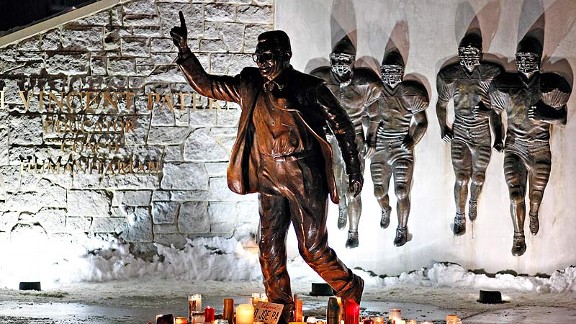 |
| When prayers to Paterno cure the sick, he'll be sanctified a saint. |
Update I: As expected, the media is overflowing today with bowing and scraping over Paterno. On Penn State campus there were a thousand candles and votive lights at the bronze shrine to the guy. Tears and lamentations.
Thursday, September 22, 2011
A Pox on Netflix
David Pogue has a great column today on what was once my, and apparently millions of other people's, favorite company, Netflix. For about $15 a month they would provide as many DVDs as you wanted to watch, just so long you didn't have more than three DVDs out at any one time. I'm not sure exactly when they went into business, but it's been a while back, and I've been with them for a long time. Later the company developed a streaming movie function, too. Different price structures depending on how many DVDs you had out at a time, but you got both services. But recently Netflix, without any warning or preparation of its customers,changed the rules of the game in a big way. They split the two functions, you could have either streaming or physical DVD, but if you wanted to have the two together, they jacked the price way up.
People were pissed. I dropped DVD service altogether. Reportedly over a million customers just left. Now the company has made matters worse. The CEO came out with an "apology" that just made people madder. I won't go into details. You can read the Pogue article. Suffice it to say, people are going to have to deal with two different outfits--Netflix for streaming video, and a new company called "Quixster" for DVDs. Two bills, two web sites. More than twice the headache.
Hell, if I weren't in the middle of "Mad Men"--an HBO TV series Susan and I are watching--I'd be inclined to drop the company too. I am paying $8 a month for streaming, and most the movies offered are distinctly second tier. Just like the company now. They are going to have to reverse field pretty quickly are they are, I think, cooked.
Wednesday, May 25, 2011
Happy Belated Birthday, Bob
Yesterday was Bob Dylan's 70th birthday. I'm just discovering that today. I copy this entire section from yesterday's Writer's Almanac. I've grown up with Bob Dylan. He's been a constant companion, and I've passed him on to my kids. All these many years--since the early '60s--I've marveled at his talent, delighted in his poetry, pondered his contradictions, and loved his music. There's none like him. His influence on music and my generation is unmeasurable.
It's the 70th birthday of Bob Dylan (books by this author), born Robert Zimmerman in 1941. He was born in Duluth, Minnesota, and grew up in nearby Hibbing, just off the road that ran all the way up from New Orleans and lent its name to his sixth album, 1965'sHighway 61 Revisited. He moved down to Minneapolis and studied art at the University of Minnesota, and though he'd started out his musical career with a rock 'n' roll band, he soon converted to folk, playing gigs at a coffeehouse, the 10 O'clock Scholar, in the Dinkytown neighborhood north of campus. Rock was catchy, but it wasn't deep enough to satisfy him, and he later said: "I knew that when I got into folk music, it was more of a serious type of thing. The songs are filled with more despair, more sadness, more triumph, more faith in the supernatural, much deeper feelings." He left Dinkytown for New York and became the darling of Greenwich Village's folk community.
By the mid-1960s, he'd gone electric, forsaking folk and returning to his rock roots. It wasn't a popular move among his fans, and at a show in England they booed him and called him "Judas." He responded by cranking the amps even louder, never one to worry about a rapport with his audience.
His lyrics evolved too, from protest songs into more literary undertakings, influenced by Paul Verlaine, Arthur Rimbaud, and John Keats (to say nothing of Dylan Thomas, who inspired Zimmerman's name change). He's been called one of America's great contemporary poets, and his lyrics are studied in college poetry classes, stripped of the music. Boston University lecturer Kevin Barents directs students to consider the iambic and ballad meter on Dylan's album John Wesley Harding. Oxford professor Christopher Ricks puts him on a par with Milton, Keats, and Tennyson. He's been nominated for the Nobel Prize in literature every year since 1996. He wrote a volume of poetry and prose calledTarantula in 1966 (published in 1971), even though he had famously proclaimed himself "a song-and-dance man" in 1965, when asked outright if he was a songwriter or a poet; The New Yorker published two of his poems from that period in 2008. Perhaps it's best to draw the distinction where he did, in the liner notes for The Freewheelin' Bob Dylan: "Anything I can sing, I call a song. Anything I can't sing, I call a poem."
He's also kept up with his art, drawing and painting to fill the time when he's on the road. Some critics compare his style to Degas, Van Gogh, Toulouse-Lautrec, and Matisse. Others say he is "spasmodically brilliant," and one art history professor said he "paints like any other amateur." The artist himself says, in his typically laconic style: "I just draw what's interesting to me and then I paint it. Rows of houses, orchard acres, lines of tree trunks, could be anything. I can turn it into a life and death drama."
Thursday, February 10, 2011
Top 50 Essential Non-Fiction Books for Weirdos
It's entries like this that make Boing Boing an essential blog for me. I challenge anybody to characterize this website in five words or less. Accurately characterize it. Because it's charm is it's utter inability to fit into some kind of box.
You will find the list with the arguments for why the book is on it right here; you should not miss the explantations. How many have you read? How many do you what to read? Hell, I'll just list them for you. The one's in bold--7 out of 50 or .140 (which is a crappy batting average, period. Plus everything I've read on this list seem rather staid compared to some of the other titles.)--are the ones I've read. But, there are a lotta books on this list I would like to read . . . does that count? There are a number of them I will read. I wonder if that counts. For those of you paying attention: you will note a plenitude of books about music and pop culture. Which, I suppose, if you're a weirdo is up your alley.
Update I: I cannot figure out how the obliteration of the titles happened, and I cannot fix it. But the link in the above paragraph will get you to the book list, and the links to the individual books actually work even behind all that clutter. Sorry.
- A People’s History of the United States by Howard Zinn
- A Supposedly Fun Thing I’ll Never Do Again by David Foster Wallace
- American Ground: Unbuilding the World Trade Center
- Columbine by Dave Cullen
- Commodify Your Dissent by Thomas Frank and Matt Weiland, Editors
- Country: The Twisted Roots of Rock ‘n’ Roll by Nick Tosches
- Critical Path by Buckminster Fuller
- Dino: Living High in the Dirty Business of Dreams by Nick Tosches
- Ego Trip’s Book of Rap Lists by Sacha Jenkins, Elliott Wilson, Jeff Mao, Gabriel Alvarez and Brent Rollins
- England’s Dreaming: Anarchy, Sex Pistols, Punk Rock and Beyond by Jon Savage
- Fast Food Nation: The Dark Side of the All-American Meal by Eric Schlosser
- Fear and Loathing in Las Vegas: A Savage Journey to the Heart of the American Dream by Hunter S. Thompson
- From the Velvets to the Voidoids: The Birth of American Punk Rock by Clinton Heylin
- Girl, Interrupted by Susanna Kaysen
- Hammer of the Gods by Stephen Davis
- Helter Skelter: The True Story of the Manson Murders by Vincent Bugliosi
- Jesse James: The Last Rebel of the Civil War by TJ Stiles
- Just Kids by Patti Smith
- Kick Me: Adventures in Adolescence by Paul Feig
- Life by Keith Richards
- Lipstick Traces: A Secret History of the 20th Century by Greil Marcus
- Low Life: Lures and Snares of Old New York by Luc Sante
- No Logo by Naomi Klein
- Nobrow by John Seabrook
- Our Band Could Be Your Life: Scenes from the American Indie Underground 1981-1991by Michael Azerrad
- Permanent Midnight by Jerry Stahl:
- Please Kill Me: The Uncensored Oral History of Punk by Legs McNeil and Gillian McCain
- Prometheus Rising by Robert Anton Wilson
- Psychotic Reactions and Carburetor Dung by Lester Bangs
- Raging Bull: My Story by Jake LaMotta
- Rock and the Pop Narcotic by Joe Carducci
- Role Models by John Waters
- Stairway to Hell: The 500 Best Heavy Metal Albums in the Universe by Chuck Eddy
- Subculture: The Meaning of Style by Dick Hebdige
- Tales of Times Square by JA Friedman
- The Basketball Diaries by Jim Carroll
- The Corporation: The Pathological Pursuit of Profit and Power by Joel Bakan
- The Culture of Fear: Why Americans Are Afraid of the Wrong Things by Barry Glassner
- The Dark Stuff by Nick Kent
- The Death and Life of Great American Cities by Jane Jacobs
- The Essential Chomsky by Noam Chomsky:
- The Ralph Nader Reader by Ralph Nader
- The Singularity Is Near: When Humans Transcend Biology by Ray Kurzweil
- The Wordy Shipmates by Sarah Vowell
- Unsung Heroes Of Rock ‘n’ Roll: The Birth Of Rock In The Wild Years Before Elvis by Nick Tosches
- Visions of Jazz: The First Century by Gary Giddins
- Voodoo Histories: The Role of the Conspiracy Theory in Shaping Modern History by David Aaronovitch
- What’s the Matter with Kansas?: How Conservatives Won the Heart of America by Thomas Frank
- Within the Context of No Context by George W.S. Trow
- You Are Being Lied To: The Disinformation Guide to Media Distortion, Historical Whitewashes and Cultural Myths by Russ Kick
Tuesday, January 4, 2011
Burn Baby Burn
Have you all heard that in the name of political correctness and trendy sensitivity, the word "nigger" is going to be taken out of Mark Twain's classics Tom Sawyer and Huckleberry Finn. Read the story here. It will be replaced by the word "slave." This is the modern-day equivalent of the Puritanical/Victorian practice of covering innumerable marble and stone penises with fig leaves, in my humble opinion. Listen, there is always going to be somebody offended by great art. It's quite inevitable. Great art doesn't care. People with little bitty narrow minds care. Salacious, vulgar, and obscene material is one thing: society has the right to protect itself from these things in certain cases. But should censorship be imposed on writing because it contains words that the purveyors of taste consider offensive? I don't think so.
Ray Bradbury, the sf writer, who penned one of the most memorable works in that genre, Fahrenheit 451, which was about a society that ordered all books burned had this to say when he was asked whether his book should be sanitized so as not to offend the young readers of today. Here's part of his response:
UPDATE I: Here is another good article on this whole subject of bowdlerizing Huck Finn and other classics.
Ray Bradbury, the sf writer, who penned one of the most memorable works in that genre, Fahrenheit 451, which was about a society that ordered all books burned had this to say when he was asked whether his book should be sanitized so as not to offend the young readers of today. Here's part of his response:
There is more than one way to burn a book. And the world is full of people running about with lit matches. Every minority, be it Baptist / Unitarian/ Irish / Italian / Octogenarian / Zen Buddhist/ Zionist/Seventh-day Adventist/ Women’s Lib/ Republican/ Mattachine/ Four Square Gospel feels it has the will, the right, the duty to douse the kerosene, light the fuse. Every dimwit editor who sees himself as the source of all dreary blanc-mange plain porridge unleavened literature, licks his guillotine and eyes the neck of any author who dares to speak above a whisper or write above a nursery rhyme.This is what any author would say, isn't it? Tart, but true. Oh, Lord, preserve us from the True Believers who are bound and determined to make us all holy, even if it kills us.
UPDATE I: Here is another good article on this whole subject of bowdlerizing Huck Finn and other classics.
Sunday, November 22, 2009
The Perfect Mascot
Some salient recent observations by Matt Taibbi about the Sarah Palin phenomenon, a subject I have studiously avoided as one likely to make the veins on my forehead and neck get dangerously swollen and enflamed. If ever there were a perfect mascot for the clueless but furious American, well, let me put it this way . . . you could not make Sarah Palin up. She so perfect in the role, it's like she stepped out of central casting to assume it. I'm sure I don't have to tell you that her ghost-written "memoir"--from what I can understand, an extended whine about the shabby treatment she got from the McCain campaign--went immediately to the top of the best-seller lists. Typical. She's going to make millions on this book, while the sorry-ass tea-party people queue up, thousands upon thousands of them, to spend their perfectly good money on drivel. Palin made no secret about the primary motive she had for writing this book: to make money. True blue American to the core.
Without further ado, Mr. Taibbi:
Without further ado, Mr. Taibbi:
- At the end of this decade what we call “politics” has devolved into a kind of ongoing, brainless soap opera about dueling cultural resentments and the really cool thing about it, if you’re a TV news producer or a talk radio host, is that you can build the next day’s news cycle meme around pretty much anything at all, no matter how irrelevant — like who’s wearing a flag lapel pin and who isn’t, who spent $150K worth of campaign funds on clothes and who didn’t . . .
- Palin — and there’s just no way to deny this — is a supremely gifted politician. She has staked out, as her own personal political turf, the entire landscape of incoherent white American resentment. In this area she leaves even Rush Limbaugh in the dust . . .
- Complaining about the assholes we interact with on a daily basis is the #1 eternal pastime of the human race. We all do it, and we get to do it every day, because the world is full of assholes. . . . Not health care, not financial regulatory reform, not Iraq or Afghanistan, but — assholes.
- Sarah Palin is on an endless crusade against assholes. It’s all she thinks about. She doesn’t really have any political ideas, in the classic sense of the word — in fact the only thing resembling real political convictions in Going Rogue revolve around the Trans-Alaska pipeline and how awesome she thinks it is. Most of the rest of the book just catalogs her Gump-esque rise to national stardom (not having enough self-awareness to detect the monstrous narcissistic ambition that in reality was impelling her forward all along, she labors in the book to describe her various career leaps as lucky accidents or mystical acts of Providence) and the seemingly endless parade of meanies bent on tripping her up along the way. [Classic Taibbi, by the way]
Wednesday, November 18, 2009
Give Peace a Chance
 I watched a movie today about John Lennon: "The U.S. vs. John Lennon," a Dutch-produced documentary about Lennon in his immediate post-Beatle phase, roughly 1969-75. It was a period in his life marked highly visible activism promoting peace, most notably the famous "bed-in's" in Amsterdam and Montreal. I can remember the reaction of people such as my parents and many people like them who if they ever gave John Lennon a thought, it was to lump him in with the incomprehensible collection of nut cases who were, in their minds, destroying the very fabric of the United States. I doubt if many of them could have identified Lennon's song "Give Peace a Chance" as coming from him. What they would say, though, is that it was a subversive song, and that radicals like John Lennon, a damned foreigner anyway, should be thrown out of the country. These were core supporters of the Nixon-instigated proceedings by the Immigration Department to deport Lennon using as a trumped up cause his conviction for marijuana possession back in England.
I cannot help but recall the polarization of the country during the Nixon administration. I was still in the Air Force when Lennon and Ono were staging these protests, and to tell the truth, I don't recall even hearing about them at the time. I was in Turkey, a crucial formative experience for me. It was there, I'm sorry to admit it, that I first realized what "poor" really meant. It was there that I saw with my own eyes how truly ugly Americans could be in the behavior and attitudes of my fellow servicemen. My experience there profoundly changed my outlook about everything: morality, politics, civil and human rights, war. So in some way, even if indirectly, Lennon, too, helped change me from the complacent, somewhat smug, unthinking U.S. occupant I was into the thoroughly engaged, and more often than not outraged, citizen I've become.
Fact is, we, the United States, have not given peace a chance. We don't believe in it; we don't revere it; we don't practice it. Peace is the furthest thing from our minds. Our persistence in the always-fruitless venture of war and destruction is, as I'm sure John Lennon would say, insanity. He wondered then, in the midst of the murderous disaster of the Vietnam war, what it was that the governments of the world actually wanted. It was a good question then, and now in the midst of our murderous disaster in the Middle East, it's a good question now.
These sentiments are of course dangerously radical, as dangerously radical as John Lennon or anyone else who challenges us to imagine a world without war.
Wednesday, October 21, 2009
Huffin' 'n' Puffin'
Every day I get the latest edition of The Huffington Post ["news blogs video community"] in my email box. And every day, or mostly every day, I read at least one of the pieces. For a couple of reasons. They almost always reflect my point of view on something, or at least some facet of my point of view, because the writers for HP are intelligent observers of the folly and outrage of contemporary American life. And HP almost always points me to aspects of the ongoing folly and outrage that in the avalanche of news (and my bounce around the web way of reading it), there's always stuff that eludes me, either because I've read it and forgotten about it, or because I'm not aware of it. This is the advantage of having a blog like the HP coming every day. So, with all that out of the way, here's what struck me today.
Arianna Huffington's lament about the absurd media circle jerk over the so-called "Balloon Boy." Are you kidding me? This is the kind of utter nonsense that our brainless cable media simply find irresistible. And it all turned out to be a hoax. They say, all these supposedly sophisticated media mavens, that all they're doing by spending hours and hours telecasting this shit is giving the people what they want. Well, that's true. The people are clueless slugs that require constant stimulation of the reptilian brain nodes. What the mavens neglect to mention is that they too love this ridiculous stuff. They only giving the people what they all want. And to think there was serious talk back at the beginning of TV--yes, I fear I am that old--of its potential to literally change humanity as a medium for dispersion of education. Arianna cannot contain her scorn today for the massive attention given to the pseudo story of the balloon boy while the 1.5 million homeless children (42% of whom are under 6 and 17% of whom have emotional problems) are ignored.
Arianna Huffington's lament about the absurd media circle jerk over the so-called "Balloon Boy." Are you kidding me? This is the kind of utter nonsense that our brainless cable media simply find irresistible. And it all turned out to be a hoax. They say, all these supposedly sophisticated media mavens, that all they're doing by spending hours and hours telecasting this shit is giving the people what they want. Well, that's true. The people are clueless slugs that require constant stimulation of the reptilian brain nodes. What the mavens neglect to mention is that they too love this ridiculous stuff. They only giving the people what they all want. And to think there was serious talk back at the beginning of TV--yes, I fear I am that old--of its potential to literally change humanity as a medium for dispersion of education. Arianna cannot contain her scorn today for the massive attention given to the pseudo story of the balloon boy while the 1.5 million homeless children (42% of whom are under 6 and 17% of whom have emotional problems) are ignored.
Tuesday, July 7, 2009
OK . . . Enough Already!
Here's what I say: Thank God they've finally got Michael Jackson in the ground--well, maybe not yet because I think the family still has a private thing to do. But the massive memorial today in Los Angeles which was broadcast live worldwide and viewed by millions is finally over. (Thousands more people came to Los Angeles from Japan, Scotland, Aftrica! just to stand outside on the sidewalk near where the memorial happened.) After almost two weeks of near saturation coverage of the death of a song and dance guy, maybe the frenzied, slavering networks can get back to their normal task of dispensing just their normal eyewash and brainless banalities. Instead of the unrelieved, breathless hype they've been spewing for days about this pop star. You would think they were covering the death of president or something. Only difference: the TV would not go on this long if it were a mere president. Nor would people be interested this long. There are people out there who have been watching TV about Michael ever since the guy died almost two weeks ago.
Here's what I say: Don't ponder too long what all this hoopla and solemnity over the death of a maladjusted pedophile freak might mean. Or what it says about our society. Might give you an Excedrin headache.
Here's what I say: Don't ponder too long what all this hoopla and solemnity over the death of a maladjusted pedophile freak might mean. Or what it says about our society. Might give you an Excedrin headache.
Thursday, June 25, 2009
The King of Pop is Dead
Michael Jackson died today. RIP. He was 50. After reaching a pinnacle beyond which few besides maybe the Beatles and Elvis reached, he led a sad and tortured life for the past 15 years or so. He was rehearsing strenuously for a massive comeback: an unprecedented 50 shows in a London arena. No official word on his death, but his abuse of prescription drugs was well known.
Most people will think of one of the huge hits off his "Thriller" album when they think of his music. But for me the two songs below are the ones I think of. Both of them still give me chills and sometimes, like now, make me cry.
I recognize almost everybody, but don't know two or three. How about you?
UPDATE I: Andrew Sullivan has a sensitive and insightful take on Michael Jackson. I agree with it.
Monday, May 4, 2009
God Talk
It somehow seems fitting that at the milestone of my 300th blog entry on Powderfinger, the subject that intrigues me today is God, religion, spirituality. For two reasons. The first, a movie--the first I've been to in a while--my spouse and I saw last evening, The Soloist with Jamie Foxx and Robert Downey, Jr. I won't dilate on the story any; you can look it up in IMDB. Wasn't all that great a movie, actually, but that's not the point. What was striking to me was the vivid reminder of how intertwined human beings are with artistic expression. The music of the movie was heavily Beethoven. There was a sizeable chunk of Symphony No. 3, part of the "Emperor Concerto," some Beethoven cello music, and also some Bach, from the unaccompanied cello suites. Which is to say the music was gorgeous. Out of this world.
 And that's my point here: to say that music is gorgeous doesn't fully plumb what the music is to us. Music as transfixing as Beethoven's says something about who we are as human beings. What is this power of music over us? Indeed, why is it that art exerts such a powerful influence over us? People will pay millions for a single painting or sculpture. Why does it grip us, hold us, ensnare us? Why are we driven to create it? Why do we visit great art again and again? Who thinks a single view of the ceiling in the Sistine Chapel or "Winged Victory" is enough? I've heard Beethoven's Symphony No. 3 at least a hundred times. But its power is not diminished in the slightest by that, in fact, the symphony becomes more entrancing the more it's heard. Examples could be strung out endlessly. Quite simply, although the assertion requires book-length exploration, art opens a window on our origins, our destiny, the shaper of our souls. It shows us who we are--this need to create the beautiful, this drive to drink it all in.
We are spiritual creatures, fashioned in some way, I believe, by a power far beyond our ability to grasp. We try to do explain and probe this mysterious ever-present power in our holy books, our many religious expressions, even our creedal formuations and rituals. But in the end, it's only art that comes close to shutting our mouths in the sheer awe of this power. We know, we sense how subtle, yet how strong, it is, how transformative in its beauty, how awesome in its mystery. It's that power, I believe, that's revealed to us in the arts, and in music especially, that finest of the arts. And it's that power that resides in us that drives humans to make art, to crave art. It's not something they choose, like being an engineer. It's something humans have to do. Like breathing.
Oh, and the second reason for the God talk I mentioned up above? Well, that will have to wait till tomorrow.
And that's my point here: to say that music is gorgeous doesn't fully plumb what the music is to us. Music as transfixing as Beethoven's says something about who we are as human beings. What is this power of music over us? Indeed, why is it that art exerts such a powerful influence over us? People will pay millions for a single painting or sculpture. Why does it grip us, hold us, ensnare us? Why are we driven to create it? Why do we visit great art again and again? Who thinks a single view of the ceiling in the Sistine Chapel or "Winged Victory" is enough? I've heard Beethoven's Symphony No. 3 at least a hundred times. But its power is not diminished in the slightest by that, in fact, the symphony becomes more entrancing the more it's heard. Examples could be strung out endlessly. Quite simply, although the assertion requires book-length exploration, art opens a window on our origins, our destiny, the shaper of our souls. It shows us who we are--this need to create the beautiful, this drive to drink it all in.
We are spiritual creatures, fashioned in some way, I believe, by a power far beyond our ability to grasp. We try to do explain and probe this mysterious ever-present power in our holy books, our many religious expressions, even our creedal formuations and rituals. But in the end, it's only art that comes close to shutting our mouths in the sheer awe of this power. We know, we sense how subtle, yet how strong, it is, how transformative in its beauty, how awesome in its mystery. It's that power, I believe, that's revealed to us in the arts, and in music especially, that finest of the arts. And it's that power that resides in us that drives humans to make art, to crave art. It's not something they choose, like being an engineer. It's something humans have to do. Like breathing.
Oh, and the second reason for the God talk I mentioned up above? Well, that will have to wait till tomorrow.
Subscribe to:
Posts (Atom)